
baking chocolate supplier iran
What you are reading in this article ...
Strategic Overview of the Industrial Chocolate Supply Chain in IranTechnical Classification: Real Chocolate vs. Compound ChocolateReal Chocolate (Couverture)Compound ChocolateFat Formulation and Technical StabilityLogistics and Quality Assurance for Hot-Climate MarketsTechnical Specifications for B2B ProcurementCocoa Solids and Fat ContentMelting Point of Fat SystemsRheology and Viscosity ManagementMicron Particle SizeChemical Purity and Quality AssuranceEvaluating Industrial Chocolate Supply ChannelsFactory-Direct Scalability and CustomizationLead Times and Production SchedulingBulk Pricing and Market DynamicsCost DriversPrice Stability and Risk ManagementCommercial Terms and Payment StructuresEstablishing Direct Supplier Contracts and PartnershipsCustom Formulation and R&D IntegrationOn-Site Technical Support and Supply AssuranceLogistics and Cold-Chain Compliance: Exporting to the GCCPackaging Standards and TraceabilityCold-Chain ParametersDomestic and Pre-Export Freight PoliciesStorage and Shelf LifeRegulatory Compliance ChecklistHow to Request an Accurate Industrial Chocolate QuotationFAQ: Common Procurement Questions for Iranian SuppliersWhat is the typical MOQ for export?How is the sample shipment process managed?How are payments structured under current trade conditions?Can we request third-party inspections before shipment?What advantages are available for high-volume orders?
Strategic Overview of the Industrial Chocolate Supply Chain in Iran
Iran has established itself as a regional hub for industrial chocolate, leveraging highly competitive energy costs and advanced manufacturing infrastructure to serve neighboring markets and global importers. Iranian production facilities now bridge the gap between European-grade processing technology and cost-optimized manufacturing, providing high-performance ingredients to both large-scale food factories and regional distributors.
For international procurement managers, sourcing chocolate from Iran can offer a strategic advantage through a favorable cost-to-quality ratio, especially when logistics proximity to GCC and CIS markets is part of the landed-cost calculation.
When evaluating potential partners, buyers should look for operational data rather than generic claims. A supplier such as Kam Kaya, for instance, operates with a stated production capacity of up to 10 tons per day, with monthly output depending on production scheduling, product mix, and confirmed order allocation. A 15-year record of stable, high-tonnage supply is the hallmark of a reliable industrial partner, distinguishing established factories from simple trading intermediaries. Factory-direct purchasing allows manufacturers to bypass middlemen, reduce procurement costs, and ensure strict quality consistency across production batches.
Technical Classification: Real Chocolate vs. Compound Chocolate
In the industrial sector, product classification is defined by the fat formulation. Understanding these differences is essential for choosing the right partner for bakery, confectionery, or pastry projects.
Real Chocolate (Couverture)
Formulated with pure cocoa butter, real chocolate delivers a premium sensory experience, characterized by a smooth mouthfeel and a long-lasting gloss.
- Performance: Requires precise tempering to align fat crystals (Form V) to achieve the signature “snap” and rapid melt-in-the-mouth texture.
- Target Application: High-end pastry production and premium confectionery brands where the sensory profile of cocoa butter is the primary requirement.
Compound Chocolate
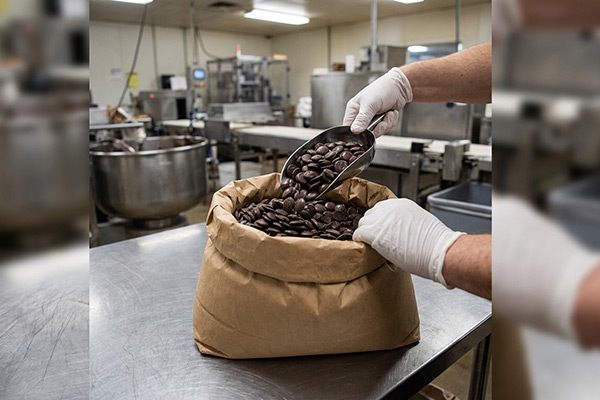
Designed for high-volume commercial production, compound chocolate utilizes vegetable fat substitutes. This category is favored for its operational stability and efficiency.
- Process Stability: Unlike real chocolate, compound formulations do not require complex tempering. They offer wider processing windows and high tolerance on standard enrobing lines.
- Customization: Leading factories can perform R&D and formulation consulting, developing custom blends based on a buyer’s existing sample, target climate, and specific production machinery requirements. These custom formulas are then archived in dedicated client files to ensure batch-to-batch consistency.
Fat Formulation and Technical Stability
The choice of fat system dictates how the chocolate performs in specific industrial applications:
- Lauric Fats (CBS – Cocoa Butter Substitute): Derived from palm kernel oil, CBS provides a sharp melt profile that closely mimics cocoa butter. Note: Under high-humidity conditions, lauric fats can be susceptible to hydrolytic rancidity if exposed to moisture, which may result in soapy off-flavors.
- Non-Lauric Fats (CBR – Cocoa Butter Replacer): CBR oils offer superior elasticity and physical stability. They are highly resistant to thermal shock, which is critical for preventing cracking on baked goods.
- Bloom Resistance: Both compound varieties offer excellent protection against fat and sugar bloom, ensuring finished goods retain visual appeal during retail distribution.
Logistics and Quality Assurance for Hot-Climate Markets
Maintaining product integrity during transit is a core part of the procurement process, particularly for shipments to the GCC. To ensure stability for destinations exceeding 35°C:
- Logistics Protocols: Use refrigerated transport for carton-based orders to mitigate temperature fluctuations.
- Dispatch Strategy: Loading should be scheduled during cooler hours—ideally after sunset—to prevent thermal shock during the initial stages of transit.
- Handling: Partner with suppliers that provide specialized food-industry logistics, ensuring that moisture barriers and packaging are optimized for the specific route’s heat and humidity profile.
Technical Specifications for B2B Procurement
When negotiating with industrial chocolate suppliers in Iran, procurement officers must request a detailed Certificate of Analysis (COA) specifying the results of the chemical analysis to ensure consistency across production batches.
Cocoa Solids and Fat Content
The percentage of cocoa solids and total fat content must be clearly defined. Suppliers may use imported or locally available cocoa powders depending on the target specification, cost structure, and the buyer’s required sensory profile. To eliminate technical ambiguity for R&D and QC departments, procurement teams should verify the cocoa powder grade, color, alkalization level, and ensure that the Technical Data Sheets (TDS), safety documentation, and Certificate of Analysis (COA) are confirmed prior to shipment.
Melting Point of Fat Systems
The melting point of the vegetable fat phase (CBS or CBR) must be tailored to the destination climate. For hot regions like the GCC, manufacturers adjust the melting point to a precise range of 34°C to 36°C (93.2°F to 96.8°F). This ensures sufficient heat resistance for the coating while guaranteeing a smooth melt at body temperature.
Rheology and Viscosity Management
Measured in Pascal-seconds (Pa·s) or Casson Yield Value, chocolate viscosity dictates flow behavior. Precise adjustment is critical for applications ranging from thin enrobing to thick deposit molding. A strategic advantage for industrial buyers is a supplier’s ability to reverse-engineer an existing production sample. This ensures the product is compatible with the buyer’s pumps, molding equipment, and coating lines without disrupting established production parameters.
Micron Particle Size
Particle size distribution directly impacts mouthfeel and machinery wear.
- 18 to 22 Microns (Premium Refined): Smooth mouthfeel, low machine wear, and superior sensory profile.
- 23 to 30 Microns (Standard Industrial): Suitable for general confectionery, enrobing, and molding.
- Above 30 Microns (Coarse): Results in a gritty texture and increased machinery wear; generally classified as low-grade.
Reliable suppliers must demonstrate batch uniformity, proving that the particle size remains stable across high-volume production runs.
Chemical Purity and Quality Assurance
The COA must certify that the product is free from unauthorized additives and conforms to international chemical tolerances. Professional manufacturers maintain physical quality control protocols, including:
- Incoming Raw Material QC: Verification of all ingredients before processing.
- Batch Uniformity Testing: Regular laboratory checks during production.
- Pre-shipment Verification: Final quality release before dispatch.
Reputable facilities often allow for product returns if a documented quality complaint or technical non-conformity is verified.

Evaluating Industrial Chocolate Supply Channels
For international B2B procurement, navigating the Iranian market requires a shift from traditional wholesale hubs to direct factory partnerships. While local marketplaces such as Tehran’s Molavi Market or Noroozkhan Alley may serve small-scale domestic buyers, they usually lack the technical infrastructure, export documentation, batch-level traceability, and formulation control required for industrial chocolate procurement.
For manufacturers, sourcing directly from a dedicated factory provides access to custom formulations, transparent QC procedures, technical support, and scalable supply planning.
Factory-Direct Scalability and Customization
Direct cooperation with a dedicated manufacturer is essential for securing custom formulations and stable pricing. Private-sector manufacturers in Iran are often preferred over large state-owned conglomerates due to their superior flexibility in production scheduling, custom tooling, and formulation adjustments.
Key advantages of factory-direct partnerships include:
- Production Capacity: Facilities with a daily output of 10 tons can comfortably support large-scale food processors, dairy manufacturers, and global exporters.
- Technical Support: Direct access to R&D teams for developing specialized compound blocks, coatings, and heat-resistant formulations.
- Logistics & Packaging: Flexible packaging formats (typically ranging from 3 kg to 12 kg units) optimized for containerized shipping.
Lead Times and Production Scheduling
For standard formulations, the lead time from formal order confirmation to vessel loading at major ports such as Bandar Abbas typically ranges between 10 to 15 business days. Under structured scheduling, lead times are managed as follows:
- Ready-Stock Items (Logistics & Customs Release): 3 to 5 business days.
- Standard Production Runs: 10 to 15 business days.
- Custom Formulations & High-Tonnage Orders: 15 to 21 business days, depending on R&D validation and packaging material readiness.
- Note: During peak seasonal demand, lead times may extend. Since production line reservation is generally not available without a signed contract, early inventory planning is critical for international buyers.
Bulk Pricing and Market Dynamics
The pricing structure for industrial chocolate in Iran is characterized by a unique balance of low domestic operational costs and international raw material variables.
Cost Drivers
- Domestic Advantages: Competitive pricing is supported by relatively lower industrial operating costs, including energy, labor, and local manufacturing overhead.
- Global Variables: Because core ingredients—including cocoa powder, CBS, and specialty fats—are imported, the final price is sensitive to international commodity markets (London/New York exchanges) and global supply chain fluctuations.
Factory-to-Port Export Cost Structure = [Raw Material Cost (Cocoa Butter/CBS/CBR + Cocoa Powder + Sugar + Emulsifiers)] + [Processing & Energy Cost] + [Packaging Specification (Outer Carton + Inner Liner / Bucket Format)] + [Quality Documentation & Pre-Shipment Handling] + [Inland Logistics to Port]
The final landed cost for GCC buyers will also depend on the selected Incoterm, sea freight, insurance, destination port charges, customs clearance, and local distribution costs.
Price Stability and Risk Management
To mitigate risks associated with currency volatility, long-term supply contracts are often structured around pricing formulas linked to official exchange systems (such as the NIMA or SANA remittance rates).
- Price Inquiries: Due to market sensitivity, Proforma Invoices (PI) typically have a limited validity period, often 48 hours.
- Hedging & Supply Assurance: For recurring supply programs, pricing can be reviewed through agreed quotation windows or formula-based mechanisms, depending on raw material availability, exchange-rate exposure, and contract volume. In some cases, suppliers may offer short-term price validity or scheduled price reviews rather than fixed long-term price guarantees.
Commercial Terms and Payment Structures
Pricing is tiered based on formulation complexity and total tonnage. High-tonnage orders (10 to 24 tons) often qualify for discounted export rates, particularly for full-container-load (FCL) procurement.
- Standard Payment Models: Usually require a 30% advance payment to initiate production.
- Settlement: Options include cash-against-documents, staged payments, or full settlement upon warehouse dispatch.
- Credit Facilities: Generally reserved for long-term, high-volume industrial partners, while initial export orders are processed on a cash/advance basis to ensure rapid dispatch.
Establishing Direct Supplier Contracts and Partnerships
Establishing a direct contract with an industrial chocolate manufacturer in Iran provides international buyers with access to dedicated technical support and custom R&D capabilities.
Custom Formulation and R&D Integration
High-volume buyers can request tailormade sensory and physical profiles, including adjusted sweetness levels, specific vanilla notes, and alternative emulsifier configurations—such as replacing soy lecithin with polyglycerol polyricinoleate (PGPR) to optimize yield stress.
The standard B2B procurement workflow follows these steps:
- Target Specification: The buyer submits target specifications or a reference sample.
- Sample Synthesis: The manufacturer’s laboratory analyzes the sample and produces a matching prototype.
- Validation: The prototype is sent to the buyer’s R&D department for validation.
- Archiving: Once approved, the exact formula is locked and archived under a unique client code to guarantee batch-to-batch consistency in future mass production.
On-Site Technical Support and Supply Assurance
To prevent costly downtime on high-speed production lines, leading suppliers offer technical consulting to resolve issues related to viscosity mismatch, poor coating adhesion, or unstable fat crystallization on the buyer’s enrobing lines.
Furthermore, direct contracts protect factories from seasonal ingredient shortages. By providing a rolling demand schedule, buyers allow manufacturers to plan raw material procurement and reserve production capacity under structured Service Level Agreements (SLAs).
To mitigate initial technical risk, sample orders for laboratory analysis can be prepared within 5 to 7 business days without minimum order quantity (MOQ) restrictions. This allows buyers to verify melting profiles, rheology, and flavor release before committing to commercial contracts.
Logistics and Cold-Chain Compliance: Exporting to the GCC
Exporting temperature-sensitive confectionery products from Iran to hot climates in the GCC requires strict cold-chain protocols to prevent melting, fat migration, and bloom.
[Factory Loading: Pre-cooled Reefer (15-18°C)] ➔ [Transit to Bandar Abbas Port] ➔ [Sea Freight to Jebel Ali / Hamad Port]
Packaging Standards and Traceability
Bulk chocolate shipments require heavy-duty packaging designed to resist physical stress and moisture absorption:

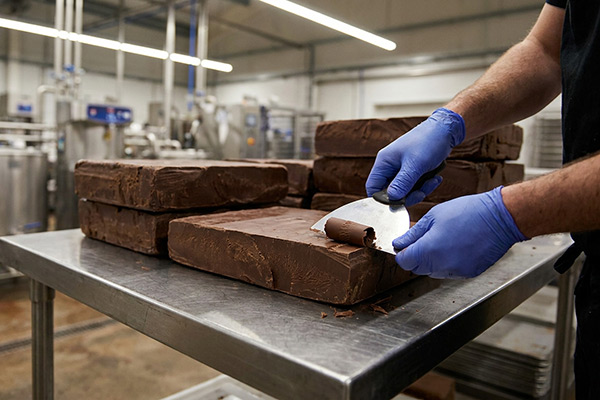
- Bulk Formats: Industrial blocks and chips are packed in food-grade, double-wall corrugated cartons with metallized aluminum inner bags and moisture-resistant liners, secured on heat-treated, phytosanitary-certified export pallets.
- Alternative Formats: Depending on the application, liquid or semi-finished coatings are supplied in 3 kg, 4 kg, or 12 kg industrial buckets, as well as standard 12 kg cartons.
- Traceability: Every unit must bear a technical label displaying the production date, expiry date, and batch number to comply with international factory audit standards.
Cold-Chain Parameters
During transit, reefers must be maintained under strict conditions:
- Temperature: 15°C to 18°C (59°F to 64.4°F).
- Relative Humidity: Moisture exposure should be minimized through proper liner selection, sealed inner packaging, and controlled container conditions. Where available, humidity monitoring or desiccant solutions may be used to reduce condensation risk.
- Thermal Protection: For any land transit where ambient temperatures exceed 35°C, refrigerated transport (reefer) is mandatory for all carton-based orders to prevent structural deformation and fat separation.
- Monitoring: Containers must be pre-cooled before loading. USB temperature data loggers must be placed throughout the cargo space to provide a continuous temperature record upon arrival at destination ports like Jebel Ali or Hamad.
Domestic and Pre-Export Freight Policies
For domestic delivery or pre-export transfer within the origin country, freight terms vary depending on the shipment type and agreed Incoterms:
- Commercial export shipments are strictly executed at FCL (Full Container Load) or equivalent high-tonnage volumes to meet customs and shipping efficiency.
- For R&D sample dispatches, transport from the factory to the designated courier or local air freight terminal is typically managed by the supplier, with onward international courier costs handled by the buyer.
- For larger confirmed domestic transfers (such as delivery to a buyer’s designated local export warehouse), suppliers may provide factory-managed transport to the exit port or logistics hub, subject to the contract’s Incoterms (e.g., FOB Bandar Abbas).
Storage and Shelf Life

Upon receipt, industrial chocolate must be stored under controlled conditions:
- Temperature: 20°C to 27°C (68°F to 80.6°F) with low humidity.
- Handling: Keep stock on pallets, away from direct sunlight, walls, and potential sources of odor contamination.
- Shelf Life: Depending on formulation, packaging structure, and storage conditions, many industrial chocolate and compound products can be supplied with a shelf life of up to 12 months from the production date. Unused portions can be resealed, provided the storage climate remains stable. Although finished compound products may remain stable under controlled ambient storage, lower reefer temperatures during long-distance transit are often selected to reduce thermal shock, fat migration, and bloom risk in hot-climate routes.
Regulatory Compliance Checklist
Buyers should verify that the supplier can provide the following documentation before shipment:
- Food and Drug Authority approval: Issued by the Iran Food and Drug Administration (IFDA) for food safety compliance.
- Relevant Iranian National Standards: Compliance with applicable national confectionery or chocolate-related standards, such as INSO 608 where applicable.
- International food safety certifications: ISO 22000 and HACCP.
- Halal certification: Approved by relevant GCC-recognized bodies to support customs clearance at ports such as Jebel Ali and Hamad Port.
- Third-party inspection (TPI): Pre-shipment inspection by firms such as SGS, Cotecna, or Bureau Veritas at Bandar Abbas or a free trade zone to verify quantity, packaging integrity, and quality compliance.
In supplier evaluation, buyers should also request factory documentation. Kam Kaya can provide COA, TDS, safety documentation, and national, ISO, health, and food and drug certificates. These documents convert production capability into verifiable trust signals for importers, technical teams, and compliance departments.
How to Request an Accurate Industrial Chocolate Quotation
To receive an accurate quotation, buyers should provide a structured RFQ rather than requesting a generic price. A complete RFQ should include:
- Product type: real chocolate, compound block, coating, chips, or filling
- Fat system preference: cocoa butter, CBS, CBR, or customized blend
- Target application: enrobing, molding, bakery, ice cream, tahini, biscuit, or confectionery
- Required melting point and climate conditions
- Target viscosity or machinery compatibility requirements
- Packaging format: 3 kg, 4 kg, 12 kg bucket, carton, block, or chips
- Order volume and repeat purchase forecast
- Destination port: Jebel Ali, Hamad Port, Sohar, Kuwait, Dammam, or other GCC destination
- Preferred Incoterm: EXW, FOB, CFR, or CIF
- Required documents: COA, TDS, Halal, health certificate, certificate of origin, and inspection report if needed
With this information, suppliers can prepare a formulation-based offer aligned with production requirements, logistics conditions, and the buyer’s cost target.
FAQ: Common Procurement Questions for Iranian Suppliers
What is the typical MOQ for export?
For commercial bulk exports (compound blocks or chips), the MOQ is typically 10 to 15 metric tons (one 20-foot container equivalent) to ensure shipping and production efficiency. For initial product testing and R&D verification, manufacturers can provide small evaluation samples (1 to 5 kg) free of charge, bypassing the commercial MOQ requirements.
How is the sample shipment process managed?
Suppliers usually send 1 to 5 kg samples by air freight for laboratory testing. Buyers can evaluate melting behavior, viscosity, and chemical profile before placing a commercial order. Kam Kaya states that sample orders have no MOQ, are free of charge, and can be prepared within 5 to 7 business days. After approval, the formula is archived in a customer file for repeat production consistency.
How are payments structured under current trade conditions?
International buyers commonly settle through regional trade offices or financial partners in hubs such as Dubai or Muscat, with invoices paid in AED, USD, or EUR. In factory-direct procurement, buyers should confirm advance payment terms, invoice validity, and final settlement timing. Kam Kaya’s standard terms include 30% advance payment, 48-hour proforma validity, and settlement upon warehouse dispatch when the advance-plus-final-payment model is used. Export orders are handled on a cash basis.
Can we request third-party inspections before shipment?
Yes. Buyers can request inspection by SGS, Bureau Veritas, or similar agencies at the warehouse or at Bandar Abbas port. The inspector verifies container pre-cooling, packaging, labeling, seals, and batch documentation before release.
What advantages are available for high-volume orders?
Large orders can qualify for stronger pricing, better logistics terms, and more flexible commercial conditions. In Kam Kaya’s model, export pricing may be lower for 10 to 24 ton orders because they improve production and shipping efficiency. This is useful for buyers that need stable monthly supply, predictable cost planning, and consistent batch performance.
 Phone number:
  WhatsApp Response: