price of a toffee in Iran
What you are reading in this article ...
What Determines the Price of Toffee in Iran?Which Iranian Toffee Types Are Most Suitable for GCC Buyers?Toffee Flavors Popular in the GCC RegionTechnical Quality Factors That Impact PricingWhat Is the Export Price of Iranian Toffee for Gulf Markets?Main Factors Affecting Wholesale PricingHow Competitive Is Iranian Toffee Compared with Regional Suppliers?Shipping, Packaging, and Logistics for GCC-Destined CargoDocuments and Certifications Required for GCC ImportsHow Can GCC Buyers Get a Precise Toffee Quotation?FAQWhat affects the final toffee price in Iran?What is the usual MOQ for bulk export orders?Are samples available before price confirmation?How long does delivery usually take?What payment terms are common?Can Gulf buyers request private label toffee?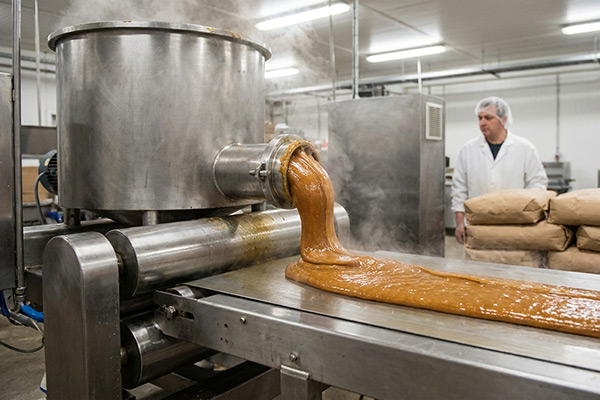
The price of toffee in Iran is usually competitive for GCC buyers when it is sourced directly from factory-level suppliers, because the final quotation can be adjusted based on formulation, MOQ, packaging format, and Incoterms. With a daily production capacity of 10 tons and 15 years of stable industrial supply to five neighboring countries, the facility provides custom solutions for dairy, ice cream, cake, cookie, and confectionery manufacturers. For importers, this means better control over unit cost, export packing, and bulk supply conditions.
What Determines the Price of Toffee in Iran?
The main driver behind toffee pricing in Iran is formulation, not appearance alone. In wholesale pricing, two products may look similar on the outside but carry very different unit costs once you compare the fat system, milk solids, milk content, fillings, and export packaging structure. For GCC buyers reviewing a price inquiry from Iran, the most useful approach is to evaluate how each recipe performs commercially, not just how low the first quote looks. Under a professional R&D sample approval process, buyers can request sample development, typically prepared within 5 to 7 working days depending on recipe complexity. Once approved, the exact formula is saved in a dedicated client folder to ensure accurate replication during mass production.
The fat phase, including fat level adjustment, is usually one of the biggest cost variables in any Iranian toffee price. A formulation based on confectionery vegetable fat or cocoa butter substitute generally supports a more cost-optimized product for mainstream channels, while recipes with higher dairy input or butter notes often serve a different target segment. In practice, a milk toffee formulation may include commercial milk powder, whey powder, glucose syrup, white sugar, refined sugar, invert sugar syrup, food-safe coloring, soy lecithin, vanillin, butter flavor, and food-grade salt, while a caramel toffee formulation may be built around controlled browning, caramel flavor, refined sugar, and carefully managed cooking time. None of these choices are inherently right or wrong; they simply produce different sensory and commercial outcomes.
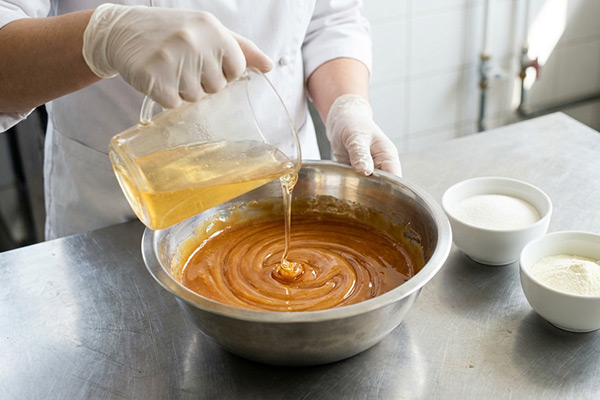
Fillings and inclusions are another major factor. A simple chewy texture in a standard wrapped format is usually more economical than a center-filled caramel piece, and the addition of pistachio, almond, or other premium inclusions naturally changes the export offer. Recipe complexity also affects manufacturing efficiency. The more technically sensitive the product is in terms of cooking mass Brix adjustment, toffee mass viscosity, cooking temperature, sugar-to-glucose ratio, and product firmness, the more attention is required for standardizing batch-to-batch production, production waste control, and incoming raw material QC. That is one reason why two apparently similar products can generate different wholesale quotations. Experienced manufacturer R&D teams can reverse-engineer target samples provided by the client, tuning sweetness, hardness, and melting characteristics to suit the precise manufacturing lines and environmental conditions of the destination market.
Packaging format also changes the commercial structure significantly. Bulk cartons for repacking are generally more efficient for buying in bulk, while small retail pouches, gift boxes, printed tins, flow-pack formats, output from a toffee cut-and-wrap machine or pillow-pack wrapping machine, and premium PP film structures all add material and labor costs. Packaging is not only a visual choice; it directly affects shelf stability, shipping efficiency, wrapping machine compatibility, and the market position of the final SKU. For GCC shipments, choosing cost-effective packaging often matters as much as recipe design. The factory packages products in robust buckets of 3, 4, or 12 kg, or in 12 kg industrial cartons, complete with technical labeling, production and expiry dates, and batch numbers.
For buyers comparing formulations, ingredient sourcing volumes, fillings, and packaging options for Gulf distribution, the most efficient route is usually direct sourcing from a supplier that can align product design with market use, rather than quoting one generic export item for every channel. To support fast procurement, proforma invoices are issued with a 48-hour validity period and require a 30 percent down payment. Payment methods are flexible, allowing phased payment or down payment with final settlement on loading ex-warehouse, though export transactions remain cash-only.
Which Iranian Toffee Types Are Most Suitable for GCC Buyers?
For GCC importers, the most suitable Iranian toffee is not always the cheapest item per kilo. It is the one that maintains shape, wrapper performance, shelf stability, product shelf life, and acceptable chewiness through hot-climate storage and distribution. That is why the supplier discussion should include technical suitability for the route and channel, not only candy price at factory-gate level.
Heat stability starts with formulation and process control. The choice of fat system, the final moisture balance, and the cooking temperature all influence whether the product remains commercially stable in transit. In warm markets, buyers often prefer a slightly firmer product profile so the toffee does not become too soft in non-refrigerated handling environments. This does not mean making the product excessively hard; it means balancing chewiness and firmness in a way that protects the product during movement across warehousing and retail chains. Specialized export logistics can support safe transport by scheduling dispatch and loading during cooler hours after sunset for hot routes, and refrigerated containers may be required for carton shipments bound for locations where temperatures exceed 35 degrees Celsius.
Wrapper release is another operational issue with direct cost implications. If the recipe is poorly balanced, toffee stickiness can create complaints, slower repacking, and a weaker user experience. Strong control over the sugar-to-glucose ratio, water activity, final moisture content, and wrapper material helps reduce wrapper stickiness and improves pack performance. Depending on the target segment, wax paper, double-twist structures, flow-pack formats, or laminated retail PP film may be selected to support better release and product shelf life.
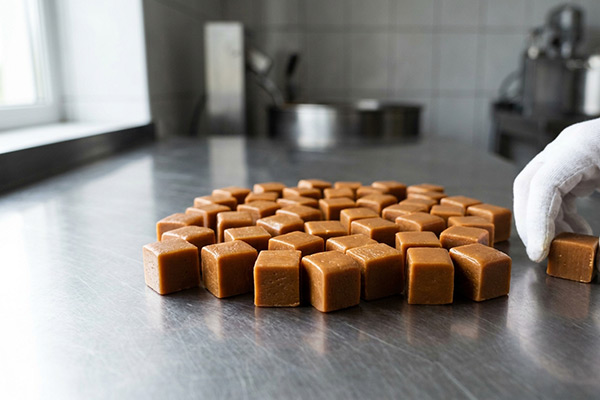
Shelf stability in GCC channels also depends on moisture control. Better management of water activity reduces the risk of stickiness, texture collapse, sugar crystallization, and sensory variation over time. This is especially relevant for mixed distribution models where products may spend time in wholesale storage, distributor vehicles, and ambient retail conditions before final sale. For this reason, a technically suitable product is often more valuable than a nominally cheaper one with weaker ambient storage stability test performance. Products can be offered with a shelf life of 12 months, provided they are stored on wooden pallets in a clean environment at 20 to 27 degrees Celsius with low relative humidity.
For GCC buyers, the most commercially suitable formats usually fall into two broad groups. Mass-volume wholesale channels often favor economical wrapped toffees with heat-conscious formulations and efficient carton packing. Premium retail or gift-oriented programs may prefer more customized recipes, individually packed pieces, and stronger visual presentation. The right choice depends on the target route to market, not on a single universal formula.
Toffee Flavors Popular in the GCC Region
Flavor selection plays a major role in commercial acceptance across GCC retail and wholesale channels, especially for buyers serving family consumption, mixed confectionery assortments, and gifting programs. In most cases, classic milk and caramel profiles remain the most commercially dependable starting point because they support broad-market distribution and high-volume repeat demand.
Milk toffee formulation usually works well when buyers need a familiar profile with stable mass-market appeal. Caramel toffee formulation can also perform strongly where a deeper cooked note and stronger caramel flavor profile fit the intended assortment. These core SKUs do not need to be replaced by more localized flavors, but they often form the base of a reliable volume program.
For buyers exploring premium or market-test assortments, saffron, pistachio, and cardamom can serve as differentiated options. Pistachio supports a more premium positioning, while cardamom-infused profiles can be useful for buyers looking for a flavor closer to familiar regional dessert notes. These options are typically most effective when used selectively in mixed lines, private label launches, or seasonal retail programs rather than as a full portfolio replacement.
Technical Quality Factors That Impact Pricing
Technical control has a direct effect on export readiness and therefore on toffee cost in Iran. Better process control improves shelf stability, wrapper release, batch consistency, and complaint reduction across repeated shipments. This matters to importers because the commercial cost of inconsistency is often much higher than the visible unit-price difference between two supplier offers.
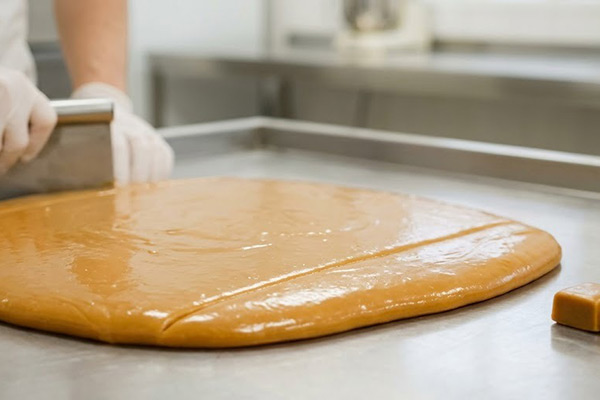
Water activity is one of the most practical quality indicators for shelf stability. Strong moisture control helps prevent toffee stickiness, texture breakdown, and excessive variation during storage and transit. The sugar-to-glucose ratio also influences product firmness, chewiness, wrap release test results, and resistance to sugar graining. Cooking temperature and cooking time affect color development, controlled browning, cook loss, and final moisture behavior, all of which influence whether the product remains stable and commercially acceptable.
When these variables are well controlled, manufacturers are better positioned to maintain batch consistency and reduce excessive hardness, wrapper stickiness, or unstable texture from one lot to the next. High-discipline production lines maintain a strict QC process with a maximum weight tolerance of 5 grams, running regular laboratory and random batch uniformity tests, alongside a final pre-shipment quality release. This is one reason a more disciplined supplier using a vacuum cooker or a toffee cooker may not quote the same Iranian toffee price as a less controlled producer, even if the visible pack format appears similar.
| Toffee Type | Approx. Piece Weight | Packaging Type | Pricing Unit | Best Fit | Main Price Drivers |
|---|---|---|---|---|---|
| Milk Toffee | 5g-7g | Double-twist, bulk cartons | Per kg / per carton | Wholesale, mainstream import | Milk solids, fat system, wrapper type |
| Caramel Toffee | 5g-7g | Double-twist, flow-pack, cartons | Per kg / per carton | Bulk distribution, mixed assortments | Controlled browning, glucose syrup ratio, packaging |
| Chocolate-Coated Toffee | 6g-9g | Flow-pack, printed pillow packs, cartons | Per kg / per carton | Mid-market retail, importer programs | Coating material, layer thickness, pack style |
| Fruit Chews | 4g-6g | Flow-pack, double-twist, bulk cartons | Per kg / per carton | Value retail, repackaging | Flavor system, color stability, film choice |
| Premium Nut-Filled Toffee | 7g-10g | Flow-pack, trays, premium cartons | Per kg / per carton | Premium import, gifting | Nut inclusion ratio, recipe complexity, pack format |
| Private Label Specialty | 5g-10g | Custom flow-pack, tins, bulk cartons | Per kg / per project | Private label, channel-specific launch | Custom wrapper, plate cost, formulation tuning |
Buyers typically use this matrix to select the right variant, then proceed to discuss recipe tuning, wrapper selection, carton structure, and shipping models with the supplier.
What Is the Export Price of Iranian Toffee for Gulf Markets?
Export pricing for toffee from Iran to Gulf markets is typically quoted per kilogram, carton, or unit, depending on the buyer’s procurement model. For wholesale and import programs, suppliers generally build quotations based on formulation, piece weight, packaging structure, and shipping terms, rather than issuing a single fixed market rate. With a daily production capacity of 10 tons, production lines are optimized for high-tonnage exports ranging from 10 to 24 tons, which results in significantly lower tiered pricing.
A practical way to evaluate an offer is to separate product costs from export structure. The product side covers ingredients, process complexity, and packaging, while the export side includes carton type, palletization, documentation, and the selected Incoterm. This allows for more accurate comparisons when buyers are reviewing multiple offers.

Cost structure for export pricing:
Toffee Export Cost Structuring = [Raw Material Mass Cost (Sugar/Glucose/Fat ratio)] + [Wrapping Film Specification (Double-twist/Flow-pack/Aluminium foil)] + [Secondary Outer Packaging (Carton/Plastic Bucket)] + [Inland Logistics & Port Handling]
For GCC buyers, this structure is more useful than comparing only the visible unit price, because formulation, wrapper performance, carton format, and export handling can all change the real landed cost of the product.
Main Factors Affecting Wholesale Pricing
- Raw material volatility: Fluctuations in the costs of white sugar, glucose syrup, invert sugar syrup, confectionery vegetable fat, milk powder, whey, vanillin, and other ingredients directly impact wholesale rates. In some cases, foreign exchange impacts on imported components are also reflected in the final price.
- Order volume and MOQ: Larger order volumes improve the allocation of fixed costs, such as industrial mixer setup, line adjustments, and machine configuration. While the standard factory MOQ for custom export runs is typically 5 to 10 tons, or one 20ft container equivalent, to optimize machine line configuration, bulk orders ensure maximum line optimization. For high-volume contracts, suppliers offer tiered discounts, flexible payment terms, and dedicated transport planning for commercial export cargo.
- Export packaging type: Bulk cartons are generally the most economical choice. Alternatives such as flow-pack wrappers, wax paper, PP film, custom tins, or retail-ready packs increase material and labor costs. Choosing cost-effective packaging significantly influences the final price.
- Certifications and documentation: Costs associated with securing COAs, health certificates, Halal certification, HACCP, ISO 22000, and other compliance documents are often factored into the export pricing structure.
- Transportation and Incoterms: The choice between EXW, FOB, and CFR defines the distribution of costs and risks between buyer and seller, directly impacting the final landed cost of the shipment.
- Payment terms: Settlement methods, advance payments, letters of credit, and long-term supply agreements can influence financial risk assessments and, consequently, final quotations. Regular B2B supply agreements can be structured based on the buyer’s planned demand schedule.
- Private label and customization: Private label projects typically include costs for design, packaging roll printing, formulation adjustments, and compatibility testing for wrapping machines. These initial project costs are distinct from recurring production rates.
How Competitive Is Iranian Toffee Compared with Regional Suppliers?
For GCC buyers, Iranian toffee is competitive when price, lead time, customization capability, and import documentation readiness are aligned. The primary advantage of direct factory sourcing is the ability to negotiate formulation, packaging, and shipping terms without unnecessary distribution layers, which reduces manufacturing costs and improves control over the final price.
Regarding lead time, Iran’s geographic proximity to Gulf markets supports faster decision-making and flexible planning for bulk purchases. Standard industrial schedules typically require 10 to 21 working days after confirmation, depending on production-line traffic, raw material availability, wrapping-film readiness, and export documentation requirements. During peak holiday seasons, lead times may increase, requiring forward-looking inventory planning as line reservations cannot be guaranteed. Regarding customization, private label projects—including sweetness adjustment, piece weight selection, and packaging format—are handled through a structured sample approval and production-planning process. For documentation, importers should ensure that key paperwork, such as invoices, packing lists, certificates of origin, COAs, and health and quality certificates adhering to Iranian national confectionery standards, are prepared for the destination market.
Shipping, Packaging, and Logistics for GCC-Destined Cargo
Successful toffee shipments to GCC markets depend not only on product quality; packaging structure and shipping method are also part of the project’s technical requirements. Export cartons must be strong enough to withstand pressure, stacking, palletization, loading, and handling from warehouse to port. Outer-case quality matters not only for physical protection but also for orderly presentation at destination and efficient multi-channel distribution.
The choice between a dry container and a reefer should be based on the product formula, shipping season, and route risk. More stable products can be shipped in a dry container under suitable conditions, while a reefer may be the more appropriate option for sensitive formulations or higher-risk routes. Moisture-barrier packaging also plays an important role in preserving chewy texture, reducing stickiness, and improving shelf stability. Wrapper material and sealing quality directly affect product performance under variable heat and humidity.
Documents and Certifications Required for GCC Imports
Importing toffee from Iran into GCC markets requires compliance with both general food safety standards and market-specific regulations. The standard document set usually includes the commercial invoice, packing list, certificate of origin, and the health certificates required for food products. On the technical side, professional buyers often request a Certificate of Analysis (COA), Technical Data Sheets (TDS), and Material Safety Data Sheets (MSDS) to review product specifications and batch-level conformity.
In terms of quality and safety assurance, HACCP, ISO 22000, Food GMPs, and compliance with the Iranian National Standard for Confectionery Products are important indicators when evaluating a factory. For GCC markets, Halal certification is also essential. Some countries may impose additional labeling or product registration requirements. To protect the buyer’s commercial interest, reputable industrial suppliers may also offer product warranties and defined return procedures in cases of verified quality issues or technical non-conformity. These documents do not replace inspection, but they do help facilitate customs clearance and reduce the risk of delays at entry.

How Can GCC Buyers Get a Precise Toffee Quotation?
To receive an accurate quotation, buyers should do more than ask for the price of toffee in Iran; they should provide clear project specifications. The more complete the input data, the faster and more reliable the supplier’s response will be. A professional RFQ should include the target formula, such as milk toffee or caramel toffee, packaging and wrapper type, whether private label is required, target piece weight, initial order volume, repeat purchase plan, destination port in the GCC, and the preferred Incoterm.
When this information is clear from the beginning, the sales and technical teams can prepare a cost-optimized proposal aligned with the buyer’s distribution channel, climate conditions, and import requirements.
FAQ
What affects the final toffee price in Iran?
The final quotation usually depends on formulation, order volume, packaging format, and shipping terms. The ingredient system, piece weight, and private label requirements can all affect the export offer.
What is the usual MOQ for bulk export orders?
MOQ depends on the product type and packaging model, but export projects are generally more efficient at commercial bulk volumes than in small mixed orders. The standard factory MOQ for custom export runs usually starts at around 5 to 10 tons, or one 20ft container equivalent, depending on the formulation and packaging format.
Are samples available before price confirmation?
Yes. Most professional suppliers provide samples for product review, formulation validation, and packaging alignment before final commercial approval. Custom R&D samples may also be available under a structured sample approval process, typically prepared within 5 to 7 working days depending on recipe complexity.
How long does delivery usually take?
Lead time depends on whether the recipe is standard or customized and whether packaging materials are ready. Production planning and shipment method both affect the timeline, which typically ranges from 10 to 21 working days.
What payment terms are common?
Payment terms vary by order size, buyer profile, and export structure. Advance payment and balance-before-shipment arrangements are common in regional trade, along with structured cash payments for export cargo.
Can Gulf buyers request private label toffee?
Yes. Private label programs can include custom wrapper design, pack format, flavor direction, and recipe adjustments based on the target market.
 Phone number:
  WhatsApp Response: