
chocolate chips price in Iran
What you are reading in this article ...
What Is the Current Wholesale Price of Chocolate Chips in Iran for Export?What Determines the Price of Chocolate Chips in Iran?Real vs. Compound Chocolate Chips: Price and Quality ComparisonWhich Chocolate Chips Are Most Suitable for GCC Bakery Markets?Technical Datasheet for B2B Chocolate Chip BuyersMain Factors Affecting Chocolate Chips Wholesale Price in IranWhen Does Sourcing Chocolate Chips from Iran Make Sense for GCC Buyers?Shipping, Packaging, and Logistics for GCC Bakery Ingredient ImportsHow Can GCC Buyers Request a Chocolate Chips Quotation?FAQ: Chocolate Chips Price in IranWhy isn't there a fixed price list for export chocolate chips?Is a reefer container mandatory for GCC shipping?What is the lead time for custom R&D samples?How do you ensure compliance for UAE and Qatar customs?
General export pricing for chocolate chips is usually not published as a fixed market rate, because each order is quoted according to its Technical Datasheet (TDS), order volume, packaging format, fat system, and selected Incoterms. For GCC buyers, quotation accuracy depends on matching the formula and logistics terms to the actual bakery application.
What Is the Current Wholesale Price of Chocolate Chips in Iran for Export?
The chocolate chips price in Iran is not a fixed market rate due to the high degree of customization required for industrial applications. For B2B procurement, the final quotation is generated based on a specific Technical Datasheet (TDS) that defines the fat system, cocoa solids percentage, and thermal stability requirements.
For GCC buyers, evaluating the wholesale chocolate chips price requires a shift from “price-per-kilo” to “performance-per-batch.” Factors such as thermal stability during baking and shape retention in the baking tunnel determine the final yield and product quality. Because cocoa mass and vegetable fat markets are volatile, manufacturers provide time-sensitive proforma invoices following a formal RFQ. This process ensures that the price reflects the current global cocoa index and the specific technical needs of the buyer’s production line.
| Product Type | Typical Cocoa Percentage | Pricing Logic / Cost Drivers | Suggested Application |
|---|---|---|---|
| Bake-stable Chocolate Chips | 10–25% cocoa solids | Cost-optimized via CBS fat systems; price varies by bake-stability grade. | Industrial cookies, muffins, and high-heat baking tunnels. |
| Dark Chocolate Chips | 35–55% cocoa solids | Driven by cocoa mass volume and premium cocoa butter ratios. | Premium bakery and artisan dessert production. |
| Milk Chocolate Chips | 20–35% cocoa solids | Influenced by milk solid quality and cocoa powder intensity. | Mainstream confectionery and pastry workshops. |
| White Chocolate Chips | Typically no cocoa solids | Driven by milk powder quality and CBS crystallization stability. | Decoration, toppings, and specialty white-dough cookies. |
What Determines the Price of Chocolate Chips in Iran?
The primary driver of the chocolate chip price in Iran is the formulation complexity. While two chips may appear identical, their behavior in an industrial rotary oven is dictated by their fat system.
Real chocolate chips, formulated with cocoa butter, carry a higher cost due to the global cocoa butter market. In contrast, compound chocolate chips utilize vegetable fats like Cocoa Butter Substitute (CBS) or Cocoa Butter Replacer (CBR). For GCC manufacturers, selecting the right fat is a critical pricing decision; for instance, shipping to high-heat ports like Jebel Ali or Hamad Port requires fats with a specific melting profile to prevent clumping in non-reefer storage, which directly influences the formulation cost.
Since export prices are subject to raw material fluctuations, wholesale contracts are priced dynamically. The final quotation is structured using the following cost-build model:
Final FOB Price per Ton = Fat System Cost + Cocoa Ingredient Cost + Sugar/Milk Solids Cost + Processing & Packaging Overhead + Inland Freight to Bandar Abbas
(Note: Raw material components within this formula are indexed to current global market rates at the time of RFQ).
Each component changes according to the approved TDS. A higher cocoa-solids formula increases the cocoa ingredient share, while a bake-stable compound formula shifts more cost sensitivity toward the selected CBS/CBR fat system. Packaging format, order volume, and the selected Incoterm then determine the final export quotation.
In practice, quotations usually increase when:
- The buyer requests real chocolate instead of compound formulation.
- A higher cocoa solids ratio is required.
- Tighter chip-size tolerances are needed.
- Summer shipping conditions require additional thermal protection.
- Smaller order volumes reduce production efficiency.
Quotations may be more cost-efficient when:
- A compound system is technically acceptable.
- Standard industrial chip sizes are approved.
- Packaging is kept in bulk export format.
- The buyer aligns the RFQ with actual oven performance instead of over-specifying the formula.
A common RFQ issue in GCC bakery procurement is requesting a cocoa percentage without specifying oven type, bake profile, or dough characteristics. In practice, this often leads to samples that match the nominal spec but fail in line conditions, forcing reformulation and delaying commercial approval.
Secondary cost drivers include:
- Cocoa Intensity: The ratio of industrial cocoa powder to sugar and fat.
- Particle Size: Mini chips (typically under 6 mm) require higher precision in the chocolate depositing machine compared to standard chips (6–12 mm), affecting production yield and energy usage per ton.
- Thermal Stability: Specialized heat-resistant chocolate drops require specific viscosity adjustments to maintain shape in the baking tunnel without bleeding into the dough.
Real vs. Compound Chocolate Chips: Price and Quality Comparison
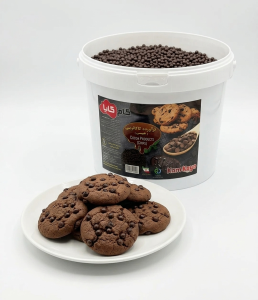
B2B buyers must choose between real and compound systems based on their product’s shelf-life and price point. Real chocolate offers superior mouthfeel but requires strict storage temperature control to prevent fat bloom. Compound chocolate chips provide a more economical high-volume supply with higher bloom resistance, making them the standard for large-scale bakery manufacturing where cost-efficiency and heat stability are paramount.
Which Chocolate Chips Are Most Suitable for GCC Bakery Markets?
In GCC supply chains, standard chips may underperform if the fat system, packaging, and transit conditions are not matched to the application and seasonal heat exposure. Importers should prioritize formulations with a high melting point and proven bake stability.
Before bulk purchase, a structured sampling process is strongly recommended, especially for GCC buyers using high-speed bakery lines or summer shipping routes. The sample should be evaluated under the buyer’s actual production conditions, not only by visual appearance.
This usually includes:
- Laboratory sample preparation based on the requested fat system, cocoa percentage, and chip size.
- Oven heat-resistance testing under the buyer’s target bake profile, such as tunnel or rotary oven conditions.
- Dough compatibility testing to check distribution, bleeding, shape retention, and post-bake appearance.
- Packaging and storage review to confirm whether dry-container shipment, thermal protection, or reefer shipment is acceptable.
Technical Datasheet for B2B Chocolate Chip Buyers
The following specifications are indicative export ranges only and must be confirmed against the final Technical Datasheet, approved sample, and batch-specific COA.
| Specification | Bake-Stable Compound Chips | Dark Chocolate Chips | Milk Chocolate Chips | White Chocolate Chips |
|---|---|---|---|---|
| Fat System / Melting Behavior | Higher-melt CBS/CBR system for improved bake stability; exact range confirmed by TDS | Cocoa-butter-based profile; requires stricter temperature control | Milk-based formula with moderate heat sensitivity; confirmed by TDS | Milk- and fat-based formula; sensitive to heat and moisture |
| Chip Size | Common industrial range: 6–12 mm; final tolerance confirmed by sample approval | Common industrial range: 8–12 mm | Common industrial range: 8–12 mm | Common industrial range: 8–12 mm |
| Viscosity / Flow | Higher viscosity for shape retention | Medium, depending on cocoa butter ratio | Medium | Medium |
| Baking Performance | Designed for higher shape retention under bakery conditions | Partial melt expected depending on bake profile | Partial melt expected | Partial melt expected |
| Shelf Life | Typically 9–12 months, depending on formulation and storage | Typically 12–18 months, depending on cocoa butter ratio and storage | Typically 9–12 months, depending on milk solids and packaging | Typically 6–12 months, depending on milk powder quality and moisture control |
| Packaging Format | 10 kg bulk cartons with food-grade liner; final format confirmed by RFQ | 10 kg or 25 kg bulk cartons | 10 kg bulk cartons | 10 kg cartons with moisture-barrier liner |
Main Factors Affecting Chocolate Chips Wholesale Price in Iran
- Raw Material Indices: Fluctuations in cocoa powder, CBS, and sugar markets.
- Production Scale: High-volume chocolate chips supply allows for optimized line runs and lower energy overhead per unit.
- Packaging Specifications: Bulk cartons with moisture-barrier liners are the most cost-effective for industrial use, whereas small foil bags increase labor and material costs.
- Logistics & Incoterms: The difference between EXW, FOB (Bandar Abbas), and CIF (Jebel Ali/Hamad) involves varying inland freight, port handling, and maritime insurance costs.

When Does Sourcing Chocolate Chips from Iran Make Sense for GCC Buyers?
Iranian supply can be a practical option for GCC buyers when the purchasing priority is a balance between formulation flexibility, regional proximity, and RFQ-based technical customization.
- Regional routing: Shorter regional shipping routes may reduce the exposure window compared with longer intercontinental supply chains, especially when thermal protection is planned correctly.
- Factory-level customization: Direct technical discussion with the manufacturer can help align fat system, chip size, packaging, and bake-stability requirements before commercial approval.
- Documentation readiness: Depending on formulation and destination requirements, shipments can be supported with Certificate of Origin, Halal certification, COA, and batch identification documents for food-control review.
Shipping, Packaging, and Logistics for GCC Bakery Ingredient Imports
To protect the product during transit to the Gulf, heavy-duty industrial master cartons with food-grade polyethylene liners are used. Shipments targeting the UAE through Jebel Ali, Qatar through Hamad Port, or Oman through Sohar/Port of Sultan Qaboos are commonly routed through Bandar Abbas, where inland freight, port handling, and container selection affect the final landed cost.
For shipments during the GCC summer high-heat window, reefer containers set to a controlled temperature range may be recommended depending on formulation, transit time, destination port dwell time, and buyer risk tolerance. In cooler periods, compound chips with a higher slip melting point may be shipped in dry containers with thermal protection, provided the buyer’s quality team accepts the risk profile. Buyers should evaluate the gross vs. net weight of the cargo to optimize container space and reduce the landed cost per ton.
How Can GCC Buyers Request a Chocolate Chips Quotation?
To receive a precise proforma invoice, the RFQ must include:
- Required Fat System (CBS/CBR/Cocoa Butter)
- Cocoa Percentage and Chip Size (mm)
- Bake-Stability requirements (for tunnel ovens vs. rotary ovens)
- Estimated Monthly Volume (for MOQ planning)
- Destination Port and Preferred Incoterm (FOB/CIF)
With these parameters, Kam Kaya can prepare a technical quotation package including the proposed formulation, packaging format, Incoterm-based price structure, estimated lead time, and required export documents for the selected GCC destination.
FAQ: Chocolate Chips Price in Iran
Why isn’t there a fixed price list for export chocolate chips?
Price is tied to the global cocoa index and the specific fat-melting profile required for your climate. A custom technical formula ensures you don’t pay for features your production line doesn’t need.
Is a reefer container mandatory for GCC shipping?
For compound chocolate with a high melting point, dry containers may be used in winter. However, during the summer, a reefer container may be recommended depending on season, formulation, transit time, and buyer risk tolerance.
What is the lead time for custom R&D samples?
Standard samples are typically dispatched within approximately 3–5 working days, while custom formulations may require around 7–10 working days, subject to laboratory workload and formula complexity.
How do you ensure compliance for UAE and Qatar customs?
Export documentation can include the Certificate of Origin, Halal certification, and a COA matching the technical datasheet, including batch identification and key quality parameters such as moisture, fat content, and microbiological limits where required. These documents support customs and food-control review at ports such as Jebel Ali and Hamad Port.
 Phone number:
  WhatsApp Response: